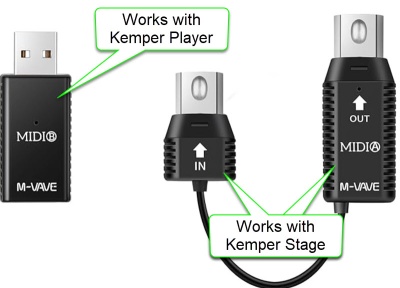
The XSONIC Airstep finds the M-VAVE USB-A automatically.
I've read that the WIDI Bud Pro works but I have not tried it.
Rig Buttons
These are the settings on the Airstep to make it mimic the behaviour of the Kemper rig buttons one through five
Switch Name
Toggle Mode
LED Display
Trigger
MIDI Type
CC#
Value
Output Interface
MIDI Channel
KPA 1
Off
Normal Mode
Press
CC
50
1
ALL
1
Release
CC
50
0
ALL
1
KPA 2
Off
Normal Mode
Press
CC
51
1
ALL
1
Release
CC
51
0
ALL
1
KPA 3
Off
Normal Mode
Press
CC
52
1
ALL
1
Release
CC
52
0
ALL
1
KPA 4
Off
Normal Mode
Press
CC
53
1
ALL
1
Release
CC
53
0
ALL
1
KPA 5
Off
Normal Mode
Press
CC
54
1
ALL
1
Release
CC
54
0
ALL
1
Summary of Kemper MIDI Logic (Slots + Morph)
CC#50–54: Load Slots 1–5 in Performance Mode or Rigs 1–5 in Browser Mode.
Morph Triggering: If the same CC is sent again (with value 1–127), Morph is engaged.
Morph Release: Sending value 0 disengages Morph.
Momentary vs Latching: Controlled by the Rig’s internal “Momentary” setting.
Why Your Airstep Setup Works
Press = CC#50–54 value 1 → Loads Rig or Slot
Release = CC#50–54 value 0 → Ends Morph (if Momentary is enabled)
Repeated Presses → Toggle Morph (if Momentary is disabled)
Single Button Logic → Matches Kemper Stage/Remote behavior exactly
Kemper MIDI Documentation
If Rig Button Morph is activated in System Settings, and the PROFILER receives subsequent control changes #50-#54 following the initial Slot load, these will trigger Morphing.
So, the same button could be used to first load a Rig, and then act as a Morph Button for that Rig. To support all functions, values 1-127 should be sent when the button is hit, and value 0 should follow when the button is released. The setting of the “Momentary” option in Rig Settings
determines whether the Morphing latches the morph sound and base sound, or if it immediately returns to the base
sound as soon as you release the button.
Effects Stomps
Airstep Bank 2 – Stomp Mode Control (Kemper Profile Player)
When I use both the Airstep and the Airstep Lite, I use the Airstep for Rig buttons (above) and the Airstep Lite for Effects Buttons (below)
CC# 75-78 to map to Effects buttons 1-4, and the last button set to Tuner on/off.
I did this instead of using CC# 17-22, which map to Modules A-D, because sometimes I use the Kemper Profile Player without the Airstep, and I wanted to use the Kemper Player mapping instead of the Profiler mappings. If I change the Effects buttons 1-4 on the Player, I wanted the Airstep to match.
Switch Name
Toggle Mode
LED Display
Trigger
MIDI Type
CC#
Value
Output Interface
MIDI Channel
Effect Button 1
On
Toggle Mode
Press
CC
75
127
ALL
1
Release
CC
75
0
ALL
1
Effect Button 2
On
Toggle Mode
Press
CC
76
127
ALL
1
Release
CC
76
0
ALL
1
Effect Button 3
On
Toggle Mode
Press
CC
77
127
ALL
1
Release
CC
77
0
ALL
1
Effect Button 4
On
Toggle Mode
Press
CC
78
127
ALL
1
Release
CC
78
0
ALL
1
Stomp (e.g. Tuner)
On
Toggle Mode
Press
CC
31
127
ALL
1
Release
CC
31
0
ALL
1
Notes
Toggle Mode On lets the Airstep track internal switch state, so LEDs reflect effect status (assuming Kemper doesn’t override).
CC#75–79 are fully valid and can be assigned to any effect slot in Kemper’s MIDI settings.
You can remap these CCs in Kemper’s System Settings to match your preferred stomp layout.
Looper
Use the Airstep Preset for KPA Looper. It works, mimicking the Profiler Foot Controller and the Kemper Stage.
For each function (e.g. Rec/Play/Overdub), there is a table with five rows. Each row represents an Airstep "Message". All the values are the same except for the second row in each table (88,89,90,91,92,93)
Airstep Configuration – Kemper Profiler Player Looper Control
Rec/Play/Overdub
Switch Name: Rec/Play/Overdub
Toggle Mode: Off
LED Display: Normal Mode
Message
Trigger
CC#
Value
Description
1
Press
99
125
NRPN MSB (Looper)
2
Press
98
88
NRPN LSB (Rec/Play/Overdub)
3
Press
6
0
Data Entry MSB
4
Press
38
1
Data Entry LSB (Execute)
5
Release
38
0
Data Entry LSB (Reset)
Stop/Erase
Switch Name: Stop/Erase
Toggle Mode: Off
LED Display: Normal Mode
Message
Trigger
CC#
Value
Description
1
Press
99
125
NRPN MSB (Looper)
2
Press
98
89
NRPN LSB (Stop/Erase)
3
Press
6
0
Data Entry MSB
4
Press
38
1
Data Entry LSB (Execute)
5
Release
38
0
Data Entry LSB (Reset)
Trigger
Switch Name: Trigger
Toggle Mode: Off
LED Display: Normal Mode
Message
Trigger
CC#
Value
Description
1
Press
99
125
NRPN MSB (Looper)
2
Press
98
90
NRPN LSB (Trigger)
3
Press
6
0
Data Entry MSB
4
Press
38
1
Data Entry LSB (Execute)
5
Release
38
0
Data Entry LSB (Reset)
Reverse
Switch Name: Reverse
Toggle Mode: Off
LED Display: Normal Mode
Message
Trigger
CC#
Value
Description
1
Press
99
125
NRPN MSB (Looper)
2
Press
98
91
NRPN LSB (Reverse)
3
Press
6
0
Data Entry MSB
4
Press
38
1
Data Entry LSB (Execute)
5
Release
38
0
Data Entry LSB (Reset)
Half Speed
Switch Name: Half Speed
Toggle Mode: Off
LED Display: Normal Mode
Message
Trigger
CC#
Value
Description
1
Press
99
125
NRPN MSB (Looper)
2
Press
98
92
NRPN LSB (Half Speed)
3
Press
6
0
Data Entry MSB
4
Press
38
1
Data Entry LSB (Execute)
5
Release
38
0
Data Entry LSB (Reset)
Undo
Switch Name: Undo
Toggle Mode: Off
LED Display: Normal Mode
Message
Trigger
CC#
Value
Description
1
Press
99
125
NRPN MSB (Looper)
2
Press
98
93
NRPN LSB (Undo)
3
Press
6
0
Data Entry MSB
4
Press
38
1
Data Entry LSB (Execute)
5
Release
38
0
Data Entry LSB (Reset)
Airstep Configuration – Kemper Profiler Player Looper Control
For each function (e.g. Rec/Play/Overdub), there is a table with five rows. Each row represents an Airstep "Message". All the values are the same except for the second row in each table (88,89,90,91,92,93)
Airstep Configuration – Kemper Profiler Player Looper Control