112 dB (estimated on total system SPL of L1 Model 1S with B2)
112 dB (cont) 118 dB (peak) (values estimated on total system SPL)
118 dB (cont) 124 dB (peak) (values estimated on total system SPL)
118 dB (cont) 124 dB (peak)
123 dB (cont) 129 dB (peak)
124 dB (cont) 130 dB (peak)
Watts RMS Active/Passive
125 Passive
250 Passive
240 Active
1000 Active
480 Active
1000 Active
1000 Active
Weight pounds
28
45
30.9
41.4
34.1
51.7
55
Drivers
Two 5.25"
Two 10"
One 7"x13" RaceTrack
One 10"x18" RaceTrack
One 7"x13" RaceTrack
One 10"x18" RaceTrack
Two 10"
Cardioid Mode
n/a
n/a
n/a
n/a
Yes
Yes
n/a
Compatibility with Bose Products
L1 Legacy
L1 Legacy
n/a not intended to be used separately
n/a not intended to be used separately
L1 Pro, L1 Legacy, S1 Pro, L1 Compact
L1 Pro, L1 Legacy, S1 Pro, L1 Compact
L1 Pro, L1 Legacy, S1 Pro, L1 Compact
Compatibility with non-Bose products
No passive, no low-pass filter
No passive, no low-pass filter
n/a not intended to be used separately
n/a not intended to be used separately
Yes active, switchable low-pass filter
Yes active, switchable low-pass filter
Yes active, switchable high-pass filter
This data is compiled from Bose Technical Data Sheets and discussions with the Bose L1 Product Managers for the unpublished data.
Two Sub1s or Sub2
Two Sub1s have approximately the same membrane surface area as the Sub2, (180 square inches).
The power difference is negligible (960 watts RMS compared to 1000 watts RMS).
Two Sub1s tightly coupled (stacked or side-by-side) should provide up to +6 dB SPL<ref> +3 dB from doubling the power and +3 dB from mutual coupling. </ref> over a single Sub1 (118 + 6 = 124). The Sub 2 is 123 dB SPL. The SPL performance of two Sub1s should be similar to a single Sub2.
The Sub1 goes down to 40 Hz. The Sub2 goes down to 37 Hz (-3 dB). The difference is due to the larger physical volume of the Sub2 enclosure. Running two Sub1s does not change the frequency response.
L1 Pro16
The SPL output of the L1 Pro16 is 118 db SPL (124 peak). The output is similar to the Sub1.
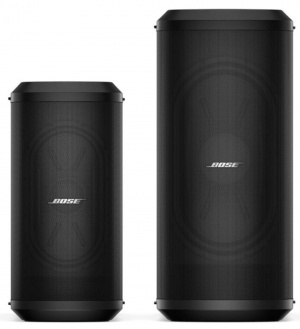
Unique RaceTrack woofers integrated in the Bose Sub1 and Sub2 modular subwoofers deliver powerful bass, have an optimized center of gravity, and save a lot of space. This slim design means you get the full impact of a conventional subwoofer without the cumbersome size, freeing up room in your vehicle and on the stage, and making every carry in between — home to car, vehicle to venue — much easier. <ref>RaceTrack Woofer on pro.bose.com</ref>
Although the comparisons are approximate and this assumes that other variables like input power are similar:
The 7"x13" RaceTrack woofer in the Sub1 is comparable to 12" round driver.
The 10"x18" RaceTrack woofer is comparable to a 15" round driver.
Note: Both the Sub1 and L1 Pro8 use a 7"x13" RaceTrack woofer.
The L1 Pro8 is rated at 240 watts RMS to the subwoofer. The Sub1 is rated at 480 watts RMS.
Cardioid Mode
Cardioid Mode
Cardioid Subs Explained
A cardioid sub configuration allows for a coverage pattern that is not unlike a cardioid microphone pickup pattern. This coverage pattern allows for most of the sound energy to be focused in front of the sub module stack while drastically reducing the sound energy that is propagated behind the subwoofer stack.
This contrasts with a standard subwoofer configuration that will act in an omnidirectional coverage pattern where sound energy propagates equally in all directions for the sub module. The main benefit of the cardioid setup is that the low frequency sound energy from your performance will be focused on the audience and not back onto the stage. This is especially helpful when amplifying large resonant acoustic instruments like drums or an upright bass. This coverage pattern is achieved by changing the direction of the second sub module driver and time aligning it using a small delay to the front facing sub module driver. This will create destructive interference behind the sub stack and results in phase cancellation of the sound energy while creating constructive interference between the modules in front of the sub stack resulting in phase summation and increased sound energy.
To accomplish this, stack two matching sub modules on top of one another as shown here. Make sure that the module facing away from the audience is at the
bottom of your stack. This configuration allows for a 10 dB SPL down point located directly behind the subwoofer stack. This configuration is possible with both the Sub1 and Sub2 modules when stacked with an identical module as seen to the left. This can be accomplished without any extra AC power runs thanks to the SubMatch cabling innovation that transmits both power and audio signal to the second subwoofer module.
Connecting and Setting Up
Connecting and setting up
To configure cardioid subs, stack two identical modules as seen to the left, connect the top sub module to an L1 Pro32 via a SubMatch cable or an external source and A/C power. Next set the top sub to positive polarity and the bottom sub to cardioid mode by pressing and holding the polarity button until the CARDIOID LED is illuminated.
Make sure that the LEVEL settings are matched across the sub modules as mismatching them will skew the performance of cardioid mode. Once this setup has been completed a 10dB down point will be present directly behind the sub stack. This performance will be extremely beneficial if your performance includes any large resonant instruments such as an upright bass or a drum set.
Note: Bose does not claim Cardioid mode increases the Sound Pressure Level (SPL) in front of the subwoofers. The main benefit is that it reduces the SPL behind the subwoofers.
See the tutorial in the video below starting at 4:05.
Why have a LEVEL control on the Bose Sub1/Sub2? This can also apply to other subwoofers as well.
Answer
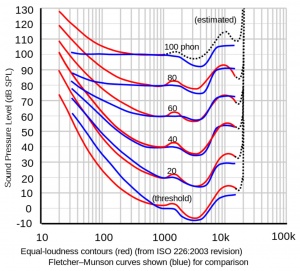
At lower volume, the Equal Loudness contour<ref>Equal Loudness contour</ref> shows that humans don't perceive bass as well as mid-highs. You can compensate for this by turning up the Sub1/Sub2 LEVEL Control.
Other times bass may seem excessive
At higher volumes
Due to boundary effects (proximity to walls and corners)
On a resonant stage
You can compensate for this by turning down the Sub1/Sub2 LEVEL Control.
You can use a Sub1 and Sub2 together. The connection will be L1 Pro32 to Sub2 to Sub1
You can stack them or place them side by side. In any arrangement where the grilles fit completely within a 30-inch (75 cm) diameter sphere, your two Subs will act like a single one, only louder. Note: Placing the Subs on either side of the L1 Pro32 power stand does not meet this criteria.
There are two options. Either is fine. Choose the one you prefer.
Option 1
Same crossover frequency applied to both Sub1 and Sub2 (200—37Hz)
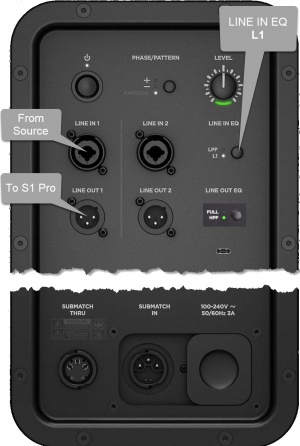
Connect the L1 Pro32 to the Sub2 (use the supplied SubMatch cable)
Connect the Sub2 to the Sub1 use a SubMatch cable (purchased separately) OR
Connect the Sub2 Line Out to the Sub1 with an XLR cable and power the Sub1 with the supplied IEC power cable.
On the Sub2 set the Line Out EQ to Full (Full Range)
Level - set to 12:00 o'clock on both. If adjustments are necessary - keep the Level Control the same on both Subs
Start with the Volume on S1 Pro and Sub, as shown. Adjust as necessary from there.
The picture shows a stereo setup. The signal flow is from left to right.
Recommended cable
Use an XLR to 1/4 inch (6.35 mm) Tip-Ring-Sleeve cable for best results.
If you use an XLR to XLR cable, the signal may be too hot for the S1 Pro system.
Alternative Connection
Can I connect the S1 Pro Line Out to the Sub?
The method described above is preferred, but you can use the S1 Pro system as the sound source (e.g., microphone and guitar and backing tracks via Bluetooth)
Note the following:
The S1 Pro system will sound the same as without the subwoofer (62 Hz - 17 kHz)
The Sub1 or Sub2 will cover from 40 Hz (Sub1) 37 Hz (Sub2) to 150 Hz
You will be able to push S1 Pro system harder (louder) if you route the signal as described at the top of this article
Sub1 and Sub2 have extruded aluminum heat sinks mounted to the backside of the I/O panel. This pulls heat out of the electronics and transfers some to the air moving through the acoustic volume of the sub and helps to cool.<ref>Bose Professional</ref>
Running Multiple Subwoofers
If you are running two or more subwoofers, you want to read these articles:
The L1 Pro8 and Sub1 use the 7" x 13" Racetrack transducer. The L1 Pro16 and Sub2 use the 10" x 18" Racetrack transducer. The following is a comparison of the performance of the L1 Pro power stands and the Sub1 and Sub2
L1 Pro8 Power Stand compared to Sub1
Both use the 7" x 13" Racetrack transducer
The L1 Pro8 power stand is 31 pounds. The Sub1 is 35.5.
The L1 Pro8 power stand is slightly smaller than the Sub1.
The L1 Pro8 power stand bass amp is 240 watts RMS. The Sub1 is 480 watts RMS.
The L1 Pro8 is 112 dB SPL continuous. The Sub1 is 118 dB SPL continuous.
The L1 Pro8 goes down to 45 Hz (-3 dB). The Sub1 goes down to 40 Hz (-3 dB).
L1 Pro16 Power Stand compared to Sub2
Both use the 10" x 18" Racetrack transducer
The L1 Pro16 power stand is 41.4 pounds. The Sub2 is 52.
The L1 Pro16 power stand is slightly smaller than the Sub2.
The L1 Pro16 bass amp is 1000 watts RMS. The Sub2 is 1000 watts RMS.
The L1 Pro16 is 118 dB SPL continuous. The Sub2 is 123.8 dB SPL continuous.
The L1 Pro16 goes down to 42 Hz (-3 dB). The Sub2 goes down to 37 Hz (-3 dB). The difference is due to the larger physical volume of the Sub2 enclosure.